Post
Mastering System Time: The Cognitive Benefits of a Silent Wall Clock
May
Mastering System Time: The Cognitive Benefits of a Silent Wall Clock
In the highly demanding environments of software development, rigorous academic study, and modern remote work, time is the ultimate, non-renewable resource. For an IT student managing deadlines at FPT Polytechnic, or a full-stack developer trying to optimize a complex backend database architecture, maintaining absolute focus is paramount. Achieving the state of deep work—often referred to as being “in the zone” or entering a “flow state”—requires the elimination of all external friction and environmental distractions. While we often think of distractions as smartphone notifications or visual clutter, auditory disruptions are equally damaging to our cognitive processing power. This is where the standard, ticking analog clock fails us, and why deploying a premium silent wall clock is a mandatory environmental upgrade for any high-performance workspace or restful bedroom.
The relentless “tick-tock” of a traditional gear-based clock might seem like a minor background detail, but to a brain trying to compile complex logic, it acts as a constant, rhythmic interruption—a cognitive “memory leak” that slowly drains your mental bandwidth. A silent wall clock completely eliminates this auditory interference. By utilizing an advanced, continuous-sweeping quartz movement, it provides the essential data of timekeeping without the distracting acoustic footprint. In this comprehensive technical guide, we will explore the mechanical engineering behind sweeping movements, the UI/UX design of optimal legibility, and why this specific piece of decor is a crucial tool for mastering your daily “runtime.”

Eliminate auditory background noise and reclaim your cognitive bandwidth with a silent sweeping mechanism.
The Mechanics of Silence: Sweeping vs. Stepping Quartz
To appreciate the value of a silent wall clock, it is essential to understand the internal hardware that drives it. Almost all modern analog wall clocks utilize a quartz crystal oscillator to keep time. When a small electrical current from a battery is passed through the quartz crystal, it vibrates at a highly precise frequency (exactly 32,768 times per second). A microchip counts these vibrations and uses them to generate a pulse of power that drives the clock’s motor.
The “Stepping” Motor Bug
In a standard, cheap analog clock, the microchip sends exactly one pulse of power per second to a “stepping” motor. This motor physically shifts the gears one rigid step forward, causing the second hand to jerk into its new position. This jerky, mechanical stop-and-start motion is what produces the audible, highly distracting “tick” sound. In a quiet room during a late-night coding sprint, this 1Hz frequency can become deafening, disrupting your train of thought and making it impossible to focus on the syntax on your screen.
The Continuous “Sweeping” Architecture
A premium silent wall clock relies on a completely different mechanical architecture. Instead of sending a single, rigid pulse every second, the microchip sends a rapid, continuous stream of micro-pulses to a specialized continuous-sweep motor. Rather than jerking forward, the gears glide in a perfectly smooth, uninterrupted circular motion.
If we apply a gaming or UI analogy, a ticking clock operates at a choppy 1 Frame Per Second (FPS). A sweeping silent wall clock operates at a flawlessly smooth 60 FPS. Because there is no rigid stopping and starting of the gears, there is zero mechanical impact. The result is a 100% silent operation. The second hand glides around the dial with elegant precision, allowing you to track time visually without paying an acoustic penalty.
Visual UI and Data Legibility
A clock is, at its core, a data display terminal. Its primary function is to deliver specific information (the current time) to the user as quickly and efficiently as possible. A well-engineered silent wall clock applies the best practices of UI/UX (User Interface / User Experience) design to its physical face.
High-Contrast Display Logic
When you glance up from your laptop or textbook to check the time, your brain should not have to spend more than a fraction of a second parsing the data. Clocks with overly ornate dials, low-contrast colors, or missing numbers force your brain to pause and “calculate” the time, which pulls you out of your flow state.
The optimal silent clock features a high-contrast design—typically a pure matte white or matte black background paired with bold, sans-serif numerals and distinctly shaped hands. This maximizes visual contrast, ensuring that the time can be instantly indexed by the eye from across the room, even in low-light conditions. It is the physical equivalent of using a clean, well-highlighted IDE (Integrated Development Environment) theme for your code.
Anti-Glare Glass Protocol
Furthermore, the protective front cover is a critical component. Standard glass reflects overhead lights and window glare, creating blind spots on the clock face. High-quality models utilize an anti-glare or flat-glass casing that minimizes light reflection, ensuring the data remains fully legible regardless of the viewing angle or the ambient lighting in your home office or living room.
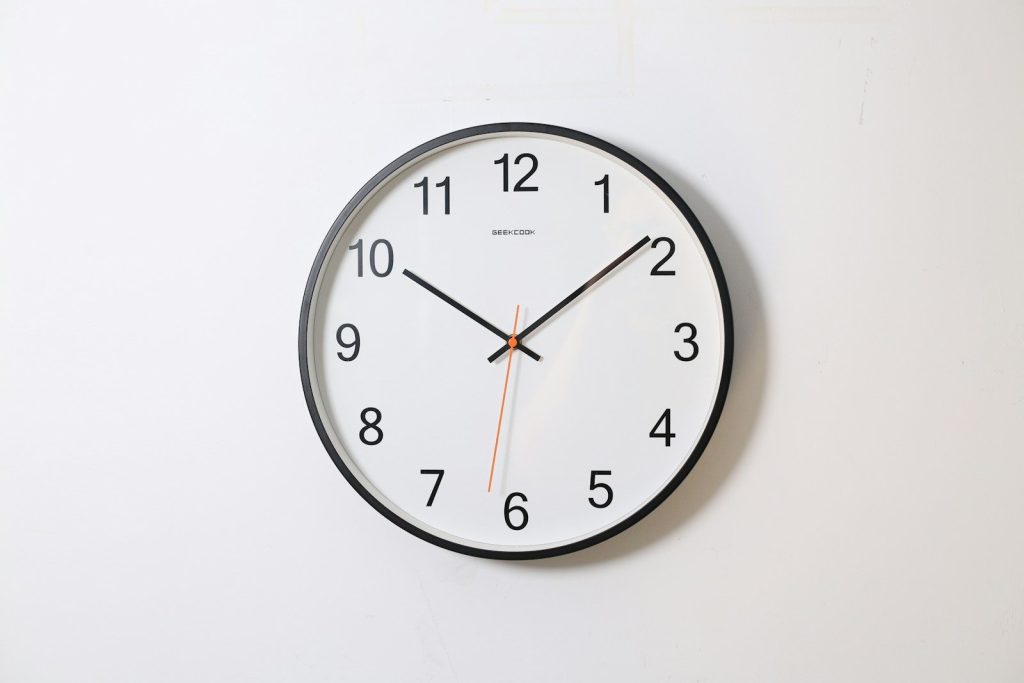
High-contrast numerals and a continuous sweeping second hand provide an optimal, low-latency visual interface.
Deployment Strategies: Optimizing Your Environment
Because it operates without emitting any noise, the silent wall clock is an incredibly versatile piece of hardware that can be deployed in any environment that requires deep focus or deep relaxation.
- The Command Center (Home Office): For developers, writers, and students, integrating this clock into your workspace allows you to seamlessly practice the Pomodoro Technique (working in focused 25-minute sprints). You can track your sprint times visually without being harassed by the ticking countdown that induces unnecessary anxiety.
- The Sleep Sanctuary (Bedroom): The bedroom should be a sanctuary optimized strictly for physical and mental recovery. Ticking clocks are notorious for causing insomnia and preventing the brain from slipping into the initial stages of sleep. A silent clock allows you to banish your smartphone (and its blue light) from the nightstand, letting you check the time if you wake up, without any auditory disruption.
- The Living Room / Media Center: When watching a quiet, dramatic movie or playing an immersive, atmospheric game, background noise breaks the immersion. A sweeping wall clock keeps you grounded in reality without competing with your sound system.
Power Efficiency and System Maintenance
Despite the continuous, smooth motion of the second hand, advanced sweeping quartz movements are highly optimized for power efficiency. A premium silent wall clock runs on a single standard AA battery. The low-friction internal gears ensure that the energy draw is minimal, meaning a single, high-quality alkaline battery can power the unit continuously for 8 to 12 months before requiring a replacement.
When it comes to installation, these clocks are designed for “plug-and-play” deployment. They typically ship with a non-trace mounting hook featuring ultra-sharp micro-pins. This hardware allows you to securely mount the clock into drywall or plaster with just a gentle tap of a hammer, leaving virtually zero damage to your walls if you ever decide to relocate your workstation.
Conclusion: Upgrading Your Analog Hardware
In a world dominated by digital screens and constant notifications, the analog wall clock remains a timeless, essential tool. However, the auditory disruption of a traditional ticking mechanism is an outdated flaw that has no place in a modern, optimized environment. A silent wall clock is a sophisticated piece of interior hardware that bridges the gap between classic aesthetics and modern cognitive needs. By offering a high-contrast visual interface and a flawless, acoustically invisible sweeping mechanism, it allows you to master your schedule without sacrificing your sanity. Deploy this silent guardian in your workspace or bedroom today, and experience the profound clarity of uninterrupted focus.
Frequently Asked Questions (FAQ)
Q: Is the clock absolutely 100% silent?
A: Yes. Because the internal motor uses a continuous sweeping mechanism rather than a stepping gear, there is no mechanical impact to generate sound. You can hold it directly next to your ear and hear nothing but the faint hum of smooth, frictionless motion.
Q: Will the sweeping motion drain the battery faster than a ticking clock?
A: While a continuous sweep does draw slightly more power than a 1Hz stepping motor, modern low-voltage quartz mechanisms are highly efficient. A single fresh AA alkaline battery will reliably power the clock for roughly 8 to 12 months.
Q: Can I use heavy-duty or rechargeable lithium batteries in this clock?
A: It is highly recommended to use standard Carbon Zinc or standard Alkaline AA batteries. High-output lithium or heavy-duty rechargeable batteries can sometimes deliver too high of a starting voltage, which can cause the delicate quartz microchip to malfunction or burn out over time.
Q: Is the glass cover reflective?
A: Premium models utilize a flat, high-clarity glass that minimizes glare compared to cheaper domed plastic covers. However, if hung directly opposite a bright, direct light source (like an unshaded window), some minimal reflection may occur. For optimal legibility, hang it on an adjacent wall.
